European Union
Customs Authority

is a new EU agency being established as part of a major customs reform to centralize data, simplify procedures, and enhance security, creating a single digital platform (EU Customs Data Hub) for businesses to interact with all EU customs, replacing fragmented national systems for efficiency and better risk management.

See more here      EUCA Brochure

Introductory Words by Prime Minister Andrej Plenković

Croatia has demonstrated strong European commitment and institutional maturity through rapid integration into the Eurozone and Schengen Area and sustained economic growth. Hosting the European Union Customs Authority in Zagreb would enhance the EU’s geographical balance while reinforcing unity, inclusiveness, and the effectiveness of the Customs Union. With centuries of customs tradition, full alignment with EU reform priorities, and proven border-management expertise, Croatia offers clear operational credibility. Zagreb provides a safe, well-connected location with modern infrastructure and a high quality of life, fully suited to the EUCA’s mission.
Welcome to Croatia! Dobro došli!

Read more

Candidacy of the city of Zagreb for EUCA

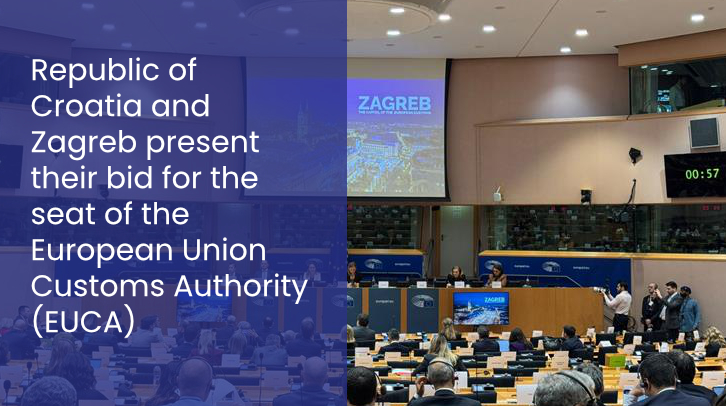
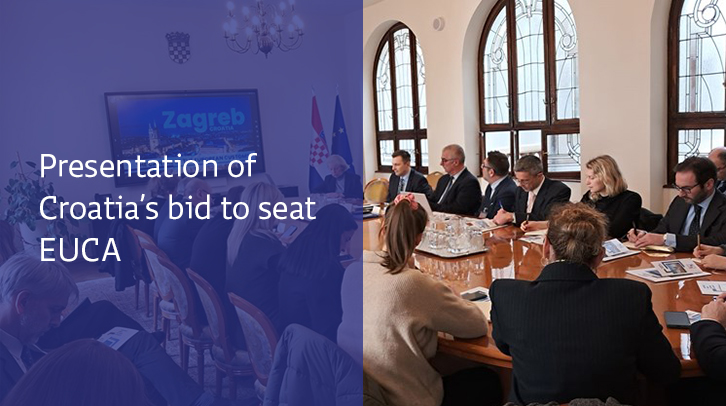
The European Union Customs Authority will unify and strengthen customs coordination across the EU, enhancing security, data management, and protection for businesses and citizens. With its strategic location, Zagreb offers unique operational advantages for hosting the Authority. As one of the safest major cities in the EU, with high living standards and excellent connectivity, Zagreb provides an ideal environment for the Authority’s work and its employees.
Ready from day one

The Croatian Customs Authority protects the longest external land border in the European Union, stretching 1397 km bordering southeast third countries, running 41 commercial customs land border crossing points, tasked with checking over 3 mil. trucks, 20 mil. cars, 50 mil. passengers, and 200 000 buses annually. In addition, controls encompass 9 international airports, 2 major international seaports for container transport, and 11 international maritime ports for passenger transport. Controls of illegal traffic annually include seizure of over 1 tonne of drugs, 7 mil. Pieces of cigarettes, 30 tonnes of tobacco, 25 hl of alcohol, 50 tonnes of illegal food, 3 mil. Pieces of medicinal products, and over 1 mil. Of counterfeited products, showing the challenge of maintaining the financial, security and safety controls, while facilitating legal business operators and securing a level playing field on the internal market of the EU. Croatian Customs Authority has been continuously investing in its service capacities. The newly built Advanced Training Centre in Bregana, 15 km from Zagreb, is intended to serve as a centre of excellence for training purposes, planned as part of the EUCA mandate.

Zagreb has daily connections to most European Union Member State capitals, and to all the major metropolitan cities via its Franjo Tuđman Airport. Zagreb is becoming a regional air hub, with each EU Member State capital reachable by air in under 3 hours. It has also created conditions for a significant increase in the number of international flight routes and passengers, with more and more low-cost carriers flying to and from Zagreb. With 64 international and 6 domestic destinations, where 20 international air companies operating, there are several flights each day between Zagreb and Brussels, as well as Frankfurt, Munich and Vienna, and daily flights between Zagreb and Paris, Amsterdam, Berlin, Lisbon, Rome, Stockholm, Zurich, Copenhagen, Bucharest, Athens, etc. Zagreb is host to almost all the major air carriers: Lufthansa, KLM, Air France, Austrian Airlines, British Airways, Emirates, Turkish Airlines, Swiss, Eurowings, among others. Their wide network of routes ensures excellent reliable connections between Zagreb and destinations within the European Union, as well as international ones. Connections during the summer season are even more frequent in view of higher tourist demand, which is an indicator of this market’s potential for further development and progress. An international railway station is in the heart of the city, and offers routes to Budapest, Prague, Vienna, Ljubljana, Munich, Zurich and Milan to the west, and Belgrade, Sofia, Thessaloniki and Istanbul to the south.

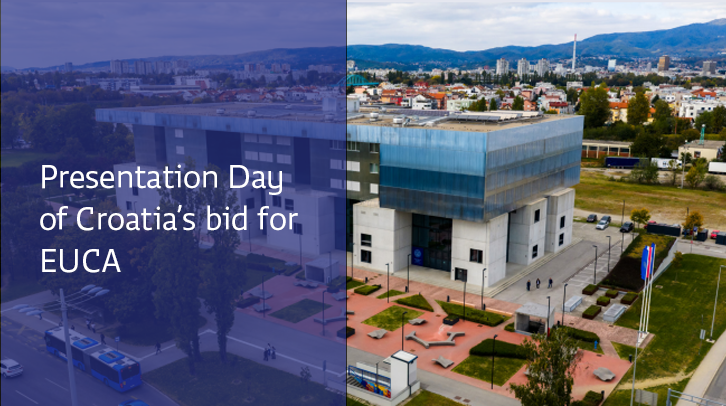
The remarkable building proposed as the seat of the EUCA, incorporating premises for 275 employees and staff, was built in 2019 and in function from 2021. It comprises 17,369.78 m2 of gross floor area on 6 levels/ floors, with a ground-floor level area of 4,630 m2, surrounding parking and park areas of 8,424 m2, combining 13,054 m2 in total of a demarcated land plot. It is compounded of architectural build in 2 cubus vertical divisions which divides building in 2 main areas. There are also external terrace facilities on the 3rd floor, an underground car park for 105 vehicles and technical and energy units in the basement, 9 different size conference/training/meeting rooms on the ground floor, with kitchen, restaurant and cafeteria facilities on the same level. The largest conference room can accommodate 678 persons (can be partitioned in half) with 16 interpretation units, and several other meeting rooms, smallest ones measuring 48.91 m2 for 20 people (also can be partitioned in half), all equipped with video-conference facilities. There are offices on the 2nd, 3rd, 4th, and 5th floors, totalling 1,012.80 m2, and additional 1,349.57 m2 of open space. There are also 45 rooms with en-suite bathrooms on the 5th floor, originally planned as accommodation units for the officials. The fifth floor also features lounge areas and light kitchen facilities. In total, as currently fitted, there are 49 offices, and 16 open space areas. The offices are generally of a modular design, and in addition to the open space areas, can be adapted to fit the required purposes. Outside, there are an additional 52 parking places, and a designated area for 128 bicycles. The building is already equipped with enhanced security features, with lasers, and restricted access areas, which can be further adapted. There is a centralised surveillance and management unit, with automatic adjustment of light and heat in each part of the building. Energy is provided by heat- pumps, running on electrical power linked to an independent power supply system. which regulates the heating. Ground water, linked to a well, is used for the cooling. Additional support is provided by the building`s own solar and wind autonomous power plants, which makes the building Nearly Zero Energy Building in energy efficiency, environment and self-sustainability policy.

The proposed seat building has an efficient transport link to Franjo Tuđman Airport. The airport is well connected with Zagreb, being only a twenty-minute drive to the city centre. Also available is a commercial shuttle-bus service to the airport with only 3 stops, running between the city’s main bus station and the airport. A shuttle bus stop is situated in front of the proposed EUCA seat building. The regular city bus line between Zagreb and the airport is another mode of transport between the airport and the city. Time needed to reach the airport from the proposed EUCA seat building is 15 minutes. The schedule is fixed in line with the arrival times of regular airlines, and operates every 30 minutes between 5 a.m. and 11:30 p.m. The City of Zagreb plans to establish an even faster connection via fast light rail/tram.

The remarkable building proposed as the seat of the EUCA, incorporating premises for 275 employees and staff, was built in 2019 and in function from 2021. It comprises 17,369.78 m2 of gross floor area on 6 levels/ floors, with a ground-floor level area of 4,630 m2, surrounding parking and park areas of 8,424 m2, combining 13,054 m2 in total of a demarcated land plot. It is compounded of architectural build in 2 cubus vertical divisions which divides building in 2 main areas. There are also external terrace facilities on the 3rd floor, an underground car park for 105 vehicles and technical and energy units in the basement, 9 different size conference/training/meeting rooms on the ground floor, with kitchen, restaurant and cafeteria facilities on the same level. The largest conference room can accommodate 678 persons (can be partitioned in half) with 16 interpretation units, and several other meeting rooms, smallest ones measuring 48.91 m2 for 20 people (also can be partitioned in half), all equipped with video-conference facilities. There are offices on the 2nd, 3rd, 4th, and 5th floors, totalling 1,012.80 m2, and additional 1,349.57 m2 of open space. There are also 45 rooms with en-suite bathrooms on the 5th floor, originally planned as accommodation units for the officials. The fifth floor also features lounge areas and light kitchen facilities. In total, as currently fitted, there are 49 offices, and 16 open space areas. The offices are generally of a modular design, and in addition to the open space areas, can be adapted to fit the required purposes. Outside, there are an additional 52 parking places, and a designated area for 128 bicycles. The building is already equipped with enhanced security features, with lasers, and restricted access areas, which can be further adapted. There is a centralised surveillance and management unit, with automatic adjustment of light and heat in each part of the building. Energy is provided by heat- pumps, running on electrical power linked to an independent power supply system. which regulates the heating. Ground water, linked to a well, is used for the cooling. Additional support is provided by the building`s own solar and wind autonomous power plants, which makes the building Nearly Zero Energy Building in energy efficiency, environment and self-sustainability policy.

Long standing cultural activities bring additional flavour to a social climate welcoming international tourists and visitors, with numerous bars, cafés, theatre and concert venues. Vibrant cultural experiences, and Zagreb’s night life take place amid a safe and secure atmosphere which is felt by both the locals and guests alike. A wide variety of cultural and social events is featured through small cinema theatres, in addition to numerous multiplex cinemas, over dozen existing theatres, numerous concerts ranging from classical to urban, ethnic, jazz and world music in larger venues, to indie, rock, punk, trap, and metal gigs in smaller venues. The medieval upper old town, built between the 11th and 18th centuries, brings history to life with stories of witches and of defence against medieval enemies. The lower old town area, built in the 19th century in the Secession style of Vienna and Austrian-Hungarian Empire, reflects the origins of contemporary Zagreb.

Amongst EU Member States, Croatia’s capital is still among those with lower costs of living, while Croatia overall, ranks eighth among the Member States as the most affordable place to live. In comparison to the reference value for Brussels, according to Eurostat, the cost of living in Zagreb is at the level of 73.5 (in comparison to Brussels, where the cost of living is at the level of 100). The staff of the European Union Customs Authority would bear lower costs of living in Zagreb than in most other capitals. In terms of the price of property purchase, Croatia ranks among the cheapest capitals of the Member States of the European Union, with an average price of EUR 2500 per m², and also ranks first in terms of the lowest price of property rental, with an average of around EUR 750 monthly for 100m2. Further, 50 % of the total population believe that it is easy to find a good apartment at an affordable price in their city, which places Croatia second among all the Member States of the European Union. Zagreb offers a competitive, attractive environment for business travel in terms of both the availability and the affordability of quality accommodation. The city has a wide selection of 4-star and 5-star hotels with ample business amenities, averaging €80–€100 per night. Croatia’s strong tourism infrastructure ensures year-round availability of hotel accommodation, even during peak season, and many venues are situated within 25 minutes from the airport, or 10 minutes from the location of the proposed seat building, in, or close to, the city centre, providing ease of mobility for visiting experts, board members, or officials. There are 1118 hotel beds available in the 5 star or higher category hotels, and an additional 1371 beds in 4-star category hotels in a 5 km radius from the building, a 15- minute car ride, or a 20-minute ride by public transport.

Government efficiency and regulatory quality measured are at 75.5 and 72.2 percentile points respectively, which is a little below the high-income OECD members (85.2 and 87.4 points). Since 2016 Croatia’s credit rating has been upgraded 5 times and, as of 2024, stands at A- (A3). Croatia has been politically stable for over 10 years, with the same political option chosen in the last 3 elections.

The fact that 32.4 % of all registered companies in Croatia are located in Zagreb clearly shows that there is no shortage of employment opportunities, considering that the registered unemployment rate in Croatia is just above 3 %. Of the European companies, INA, Lidl, Petrol, Unicredit Group, Spar, Pliva, Kaufland have regional headquarters in Zagreb, which immediately shows that the manufacturing, trade and financial sectors are most represented by foreign employers. Among the hundred largest foreign companies, there are 37 traders and distributors, 23 companies from the manufacturing industry, and 14 financiers (including six banks and five insurance companies). Among the top 1000 are also 15 international IT companies. Croatia is among the top 5 European countries with very high English language proficiency,

As for leisure, there are not many cities with below 1-million population mark offering more. Parks, like Maksimir (for hiking), or lakes Jarun and Bundek (for sports) are dotted around the city, providing green areas, with natural forest and Medvednica Nature Park, standing at 1031 meters above sea level, overlooks the city while being only a 15-minute ride from the city centre, making it easily accessible by foot, bike, bus, car, or cable-car. Sljeme offers skiing opportunities during the winter, where Alpine World Cup runs have been regularly taking place at the beginning of January. During December, Zagreb hosts its famous Advent market, featuring various cultural activities. If you wish to get away from the city to a warmer climate, the Adriatic coast is 90 minutes away, ideally reachable for a weekend-, or even a day-break.

Of the 65 nurseries, there are 4 foreign early language learning programmes: in the English, German, French and Italian languages. There are also 9 primary and secondary schools (including advanced secondary school programmes) implementing international programmes, established as French, German, British, and American schools, with learning programmes in English, German, and French. In addition, the process of establishing an accredited European School in Zagreb is underway. General Interest File has been prepared and the process is underway for finding a suitable facility to house the school. The accredited school will offer at least two language sections (English and Croatian) with a view to establishing a French, or a German section in the future, or any other EU language if there should be sufficient interest for those language sections. Interestingly enough, just around the corner, some 200 metres away from the building proposed as the seat of the EUCA is the new, large FrenchGerman Primary School. As regards University programmes, there are 117 university or university polytechnic institution programmes, with options of studying in the German, English, Italian, or Slovenian languages, and of studying French, Czech, German, Hungarian, Dutch, Polish, Portuguese, Romanian, Slovakian, Spanish, Swedish, or Italian at the University of Zagreb, Faculty of Humanities and Social Sciences. This provides a variety of options regarding higher education opportunities for family Foto: galerija.croatia.hr/hr/htz-galerija.aspx members of EUCA employees in Zagreb.

Medical services and institutions, like hospitals, medical health centres, therapy centres, ophthalmology and dental services are widely available. Public medical health centres, the primary type of public healthcare, are available in more than 700 locations across the city, and offer a wide range of medical services. There are also 17 public clinical health centres — hospitals, with internationally recognised expertise in clinical treatment and surgery. In addition, there are over 1000 private medical service providers, with several private clinical centres. Diagnostics and treatments among some of the public or private centres are internationally competitive and recognised.

In the European context, the Republic of Croatia is established as a safe, stable, and technologically advanced country, with efficient institutions and a high level of public safety. The border control system, police efficiency and international cooperation, especially with FRONTEX, show that Croatia contributes to the security and stability of the entire European Union in the long term. Thanks to its low crime rate, absence of terrorist threats, and high level of digital readiness, Croatia represents a reliable basis for operations, and also the location of European institutions and agencies. Croatia is one of the EU Member States with no record of any terrorist incidents in the past ten years. According to the TE-SAT 2025 report (Europol), Croatia remains in the category of countries with “minimal security risk”. The PNR (Passenger Name Record) and the EES (Entry/ Exit System) systems allow for digital processing and exchange of passenger data at external borders. In addition, as of 2021, Croatia is the only EU member with access to the bases of the US Terrorist Screening Centre, which further increases the level of protection. In the field of cyber security, Croatia has established the National Cyber Security Centre, and actively cooperates with ENISA, within the framework of the implementation of the EU Cybersecurity Act. In the last five years, a systematic digital modernisation of the security sector has been carried out. The Ministry of the Interior has developed interoperable systems linked to the judiciary, customs and European security databases.

Key innovations

  • introduction of the E-Crime system (digital processing of criminal offenses in real time),
  • development of AI solutions for predictive analytics and anomaly detection,
  • modernisation of the Police Operational Communication Centre,
  • Qlik Sense and ArcGIS systems for visualisation of risks and criminal patterns.
This technological capacity places Croatia among the most advanced member states in the field of digital security and analytical predictability. Croatia consistently records very high ratings for security and social stability, according to international indices. These indicators confirm that Croatia has a low level of violence, high institutional reliability and citizens’ trust in security institutions. Over the past two years, the security situation in Croatia has maintained a very favourable trend. In the first six months of 2025 no cases of terrorism, extremism, or violent radicalism were recorded. The number of criminal offences has decreased by approximately 1 %, and the overall resolution rate has remained at a high level of around 70 %.

Mild continental climate is only 100 km away from the Mediterranean coast, and reachable in just 90 minutes. The Mediterranean coast, stretching over more than 1000 km, and with over 1000 islands, is the heart, and the birthplace of the medieval Croatian kingdom, built on the remnants of the Roman Empire. It offers not only beautiful leisure capacities, but also rich historical heritage and monuments. Between Zagreb and the coast, only 50 km away, there is a high plane area stretching approximately 50 km wide, with natural wild forest, mountain peaks, hiking routes, and rivers and hills in between, offering recreational skiing facilities during the winter season.

Zagreb offers a secure, well-connected base for the EU Customs Authority, enchancing EU customs coordination and protection.

EUCA@carina.hr